Understanding Types Of Stuttering Disfluencies
December 23, 2020

American Institute for Stuttering


If you're a parent and hear your child having breaks or bumps in their speech, you may wonder whether these are typical disfluencies or stutter-like disfluencies.
"Speech fluency" refers to how smooth our speech is when we talk.
Everyone has disfluencies when they talk, and "typical disfluencies" are a normal part of the way we communicate. A speech disorder only occurs when disfluencies significantly impair communication. Correctly classifying the child's speech can help guide appropriate treatment.
In this article you'll learn what stuttering is, types (developmental, neurogenic, psychogenic), common speech characteristics and secondary behaviors, when to seek a thorough evaluation, and how AIS speech therapists help with fluency disorders.
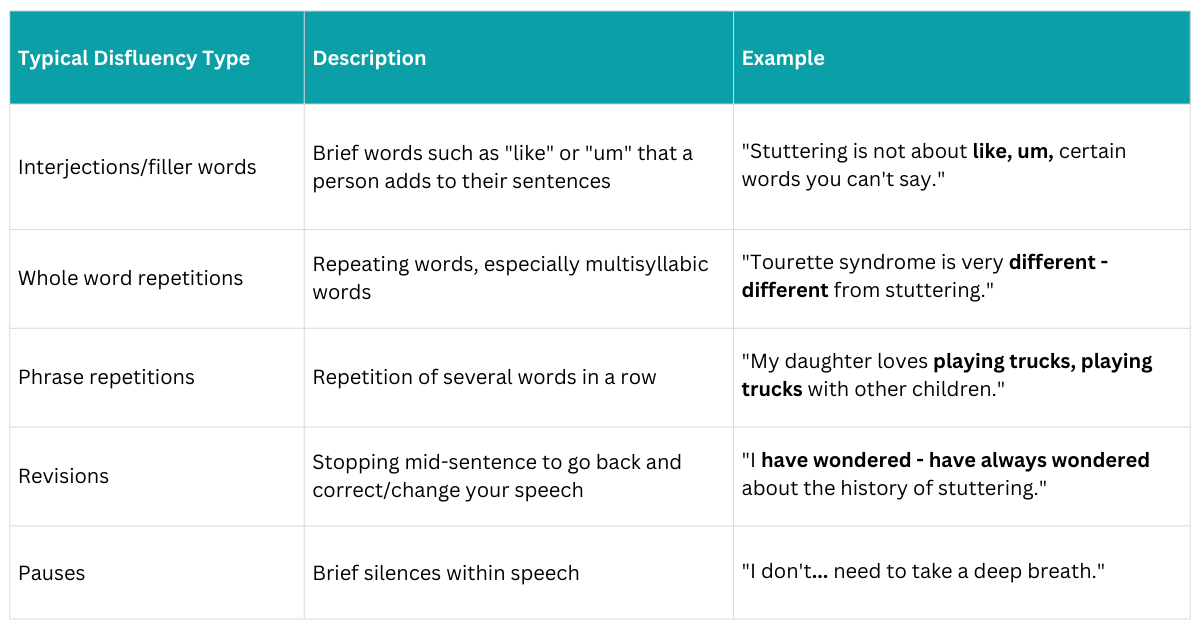
Here are typical disfluency types that can occur in an individual's speech and do NOT indicate fluency disorders, because they are typical disfluencies that we all have in our speech.
Typical Disfluency Type
Distinguishing between typical disfluencies and stuttering patterns can feel overwhelming—especially when you're wondering if your child's speech development is on track.
If you're noticing repetitions, prolongations, or blocks that seem different from typical speech pauses, or if you simply need reassurance and professional guidance, AIS's parent support programs are here to help. You'll gain clarity, practical strategies, and connection with other families navigating similar questions. Explore our parent support resources.
If typical disfluencies do not indicate stuttering, then what types of speech disfluency do speech language pathologists look for when diagnosing stuttering?
What matters for standardized measures such as the Stuttering Severity Instrument (SSI) is the type of disfluency, the duration of the each stuttering event, and the effort required to speak. Research shows us that more disfluencies in verbal output do not necessarily mean greater impact, so a good evaluation will also include an assessment of the impact on the speaker’s experience.
Unlike typical disfluencies, stuttering involves a feeling of loss of control. There are three core types of stutter-like disfluency that speech language pathologists consider stuttering:
Stutter-Like Disfluency Type
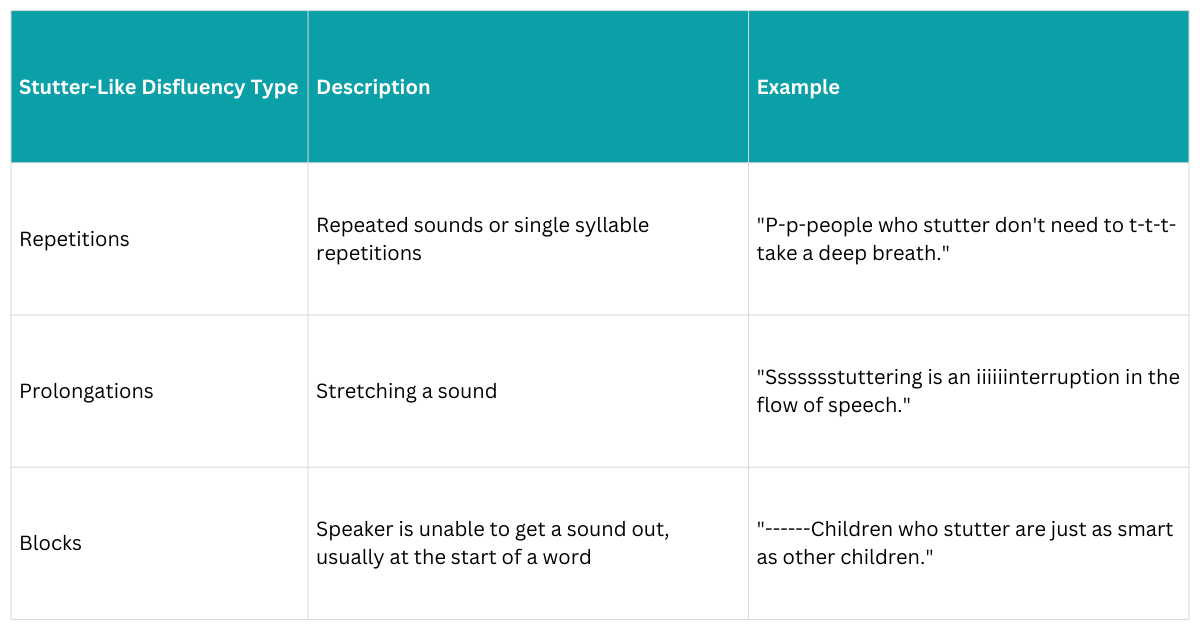
Note that whole word repetitions in a person’s speech patterns are a gray area. When a whole word is one syllable, repeating it may be a stutter-like behavior.
Understanding the difference between typical disfluencies and stuttering patterns can be challenging for parents. If you have questions about your child's speech development or need guidance navigating a fluency disorder diagnosis, AIS offers comprehensive support to help families every step of the way. Learn more about parent support resources.
While the primary behaviors of stuttering include prolongations, blocks, and sound or syllable repetitions, there are also accompanying behaviors called "secondary behaviors" or "struggle behaviors."
Some are physical, such as eye blinking, body movements, or loss of eye contact. Typically, these behaviors develop as a way of responding to the discomfort of stuttering.
For example, if a person blinks their eyes it may help them get out of a stuttering block. But as they get used to the behavior, they may need to do it more and more to achieve the same effect, until they have rapid eye blinking ingrained as a habit.
Such habits can feel very tense, and may contribute to the individual's speech being harder to understand.
Learning to recognize and address secondary behaviors is an important part of the therapeutic journey, and you don't have to navigate it alone. AIS support groups and group therapy sessions provide a safe space to share experiences, practice new techniques, and connect with others who understand the physical and emotional aspects of stuttering.
Explore our support groups and group therapy options.
Other concomitants of stuttering are social/emotional, such as avoidance behaviors, changes in self-confidence, and speaking less.
It's important to remember that these behaviors don't happen in a vacuum, and are often a reaction to negative reactions from others to differences in speech fluency. Think about it: if children who stutter encounter multiple negative reactions, it makes sense that they might develop fears or tension around certain words or speech as a whole.
The American Speech-Language Hearing Association (ASHA) emphasizes the importance of treating the whole picture of stuttering and other fluency disorders.
Developmental stuttering begins in early childhood. While many preschool children who stutter (around 80%) will stop stuttering, 20% will persist.
Persistent childhood stuttering is especially likely in boys, children with a family history of stuttering (at least one family member who stutters or stuttered), and children with other speech and language problems.
While early intervention is not a cure for stuttering, it is important to prevent children who stutter from developing struggle behaviors and negative emotions that can make stuttering a larger lifelong problem if the child continues to stutter.
To learn how young children who stutter can receive early intervention at AIS, see Stuttering Therapy for Preschoolers.
Neurogenic stuttering is when a person develops stuttering later in life as a result of a change in the way the brain works, usually as a result of a stroke or traumatic brain injury.
More rarely, conditions like Parkinson's, multiple sclerosis, or tumors can cause changes in speech production that may include neurogenic stuttering or other fluency disorders.
Fluency disorders acquired in this way require a thorough evaluation by a neurologist as well as a speech language pathologist. They can use their assessment tools to analyze speech characteristics in the context of the underlying cause of the neurogenic stuttering.
Usually, recovery from neurogenic fluency disorders follows a similar course to the recovery from the overall brain disorder. Speech therapy can help regain comfort in the speaker's experience and reduce the effort required to communicate.
Treating neurogenic stuttering requires specialized knowledge that goes beyond typical developmental stuttering approaches. For clinicians seeking to expand their expertise in stuttering across diverse etiologies and contexts—including neurogenic cases—AIS offers comprehensive professional training that combines evidence-based methods with practical clinical skills.
Learn more about AIS professional training programs.
Psychogenic stuttering is a fluency disorder resulting from emotional and psychological, rather than physical, changes to how the brain works.
It's important to remember, however, that such a speech disorder is real: it is not in the person's control and should not be seen as "all in their head." Speech language pathologists who specialize in fluency disorders will be careful to avoid such stigmatizing language.
Appropriate treatment will acknowledge the difficulty of the speaker's experience while working with them to create a treatment plan that will address negative feelings, increase self confidence, and reduce avoidance behaviors.
Whether your stuttering has roots in emotional trauma, stress, or other psychological factors, you deserve compassionate, specialized care that honors your experience without judgment. AIS therapists understand the complex interplay between emotions and speech, and will work collaboratively with you to develop a personalized treatment plan that addresses both the psychological and communication aspects of your journey. Start your personalized stuttering therapy.
Parents who observe speech disfluency in their children often want to know what the chances are that the stuttering will persist.
While there are no perfect predictors of stuttering persistence, risk factors include: family history (a family member who stutters), male sex, later onset, longer time since onset, and concomitant speech disorders (e.g. difficulty with certain speech sounds).
Early intervention is not a cure, but it can help prevent problems if the child continues to stutter. Speech language pathologists can work with each child's individual needs to promote self confidence, reduce negative perceptions of stuttering, and help most children speak as easily as possible.
A speech language pathologist is especially essential if you observe visible visible strain (physical tension), or growing avoidance behaviors. Many children benefit from parent training to create a stutter-friendly environment at home.
AIS's parent support programs provide guidance, reassurance, and practical strategies to help you support your child effectively—whether stuttering persists or resolves naturally. You don't have to figure this out alone. Connect with AIS parent support resources.
At AIS, our speech language pathologists are stuttering experts who truly understand the experience of stuttering, and the treatment techniques that work best for fluency disorders. They are ready to help you with diagnosis and with creating an individualized treatment plan.
Meet our team of speech language pathologists.
At AIS, we are passionate about stuttering. We tailor our treatment by age and goals to provide each client with care plan that works for them.
No matter where you are in your stuttering journey—or which age group you're seeking support for—AIS offers specialized programs designed to meet you exactly where you are. From early childhood intervention to adult communication strategies, our comprehensive approach ensures everyone receives the evidence-based care they need.
Compare our stuttering therapy options and find the right fit for you.
Stereotyped perceptions and negative reactions to stuttering are what make it hard. It's perfectly normal to have some difficult feelings about a speech pattern that is so stigmatized.
While working with a speech language pathologist can help find relief from the fear and shame of stuttering, it's also hugely beneficial to connect with others who stutter.
At AIS, we encourage our clients to find community through support groups, speaker events, workshops, and community outings.
Connecting with others who truly understand your experience can be transformative—building confidence, reducing shame, and reminding you that you're not alone. Whether you're looking for peer support, shared experiences, or simply a space where you can be yourself without judgment, AIS's community is here for you. Find your community through our support groups and events.
At AIS you can expect collaborative goals and individualized strategies grounded in evidence and our therapists' connection to the stuttering experience.
We’d love to help you or your loved one take the next step to speak freely, and live fearlessly. Call us at 212-633-6400 or contact us online to get started today.
Worried about the cost of therapy? Our Freeing Voices, Changing Lives Scholarship Fund offers need-based financial assistance, thanks to generous donors. Many applicants who thought they wouldn’t qualify are pleasantly surprised to receive support.